Finding the right hair dryer can make a big difference in your daily routine. With so many options available, some built for salon-level speed, others for travel convenience, it can be hard to choose the best one for you. In this guide, we’ve compared nine of the top hair dryers on the market, based on real specs and genuine owner reviews rather than marketing copy, to help you find the right fit.
In this guide:
- Quick comparison of all nine dryers
- What RPM, wattage, and “negative ion technology” actually mean for your hair
- Full breakdown of each dryer, pros and cons included
- How to keep any hair dryer performing well for longer
Quick comparison
| Model | Rating | Best for |
| 7 in 1 Professional Hair Styling Tool | 5.0 (42) | All-in-one styling, not just drying |
| 5-in-1 Air Styler with Travel Case | 4.4 (208) | International travel, dual voltage |
| Professional Hair Dryer, 2000W | 4.7 (408) | Custom styling, dual voltage |
| Dual Voltage Ionic Hair Dryer, 2000W | 4.8 (40) | Travel, magnetic attachments |
| Slopehill Hair Dryer with Brushless Motor | 4.5 (3,461) | Strong airflow, well-proven |
| Ionic Hair Dryer, 150000 RPM | 4.4 (650) | Compact travel option |
| High-Speed Hair Dryer, 500M Negative Ions | 4.4 (1,148) | Fast everyday drying |
| 150000RPM Professional High-Speed Hair Dryer | 4.9 (87) | Digital control, top-rated |
| Slopehill Professional Ionic Hair Dryer | 4.4 (12,116) | Best budget, most reviewed |
What the specs actually mean
Before the individual picks, it’s worth understanding what these numbers actually tell you, since most listings lead with them. If you’re the type who likes buying decisions backed by real specs rather than marketing copy, this is the same approach we take across our tested gadget guides.
RPM (motor speed). Traditional hair dryer motors run around 3,000-20,000 RPM. Modern brushless motors, the kind used in nearly every dryer on this list, typically run 100,000-150,000 RPM, and some premium models go higher still. Higher RPM generally means faster airflow and shorter drying times, roughly half the time of a traditional dryer, but it’s not the only factor. Wattage and nozzle design matter too, a high-RPM motor with a poorly designed airflow path can still underperform a lower-RPM dryer with better engineering.
Wattage. Most dryers here sit in the 1600-2000W range, which is the sweet spot for thick or long hair that needs efficient drying without excessive heat. Lower wattage isn’t necessarily worse, it just means longer drying times, which can actually mean less cumulative heat exposure for finer hair.
Negative ion / ionic technology. This isn’t marketing fluff, ionic dryers genuinely release negatively charged ions that help break down water droplets on the hair surface faster and reduce the static that causes frizz. The effect is real but modest, expect smoother, shinier-looking hair, not a dramatically different drying experience.
Dual voltage. If you travel internationally, this matters more than almost any other spec. A dual-voltage dryer (typically 110-240V) works with a simple plug adapter anywhere in the world. A single-voltage dryer needs a full voltage converter, not just an adapter, or you risk damaging it, or worse, in countries with different mains voltage.
7 in 1 Professional Hair Styling Tool
A genuine multi-tool rather than a dedicated dryer: seven attachments cover straightening, curling, and volumising alongside drying. The powerful motor keeps drying quick despite the added versatility, and the smart control interface gives precise styling options rather than a single fixed setting.
Pros:
- Seven different attachments for versatile styling
- Powerful motor dries hair quickly with minimal heat damage
- Smart control interface for precise styling options
Cons:
- Higher price point than dedicated dryers
- Can be bulky for those with limited storage space
- The number of attachments may feel overwhelming at first
5-in-1 Air Styler with Travel Case
Built specifically with travellers in mind: dual voltage means no converter needed abroad, and it combines a dryer, straightener, and curler into one compact tool that saves both space and money compared to carrying three separate devices.
Pros:
- Dual voltage, genuinely useful for international travel
- Combines multiple styling tools into one compact device
- Reduces frizz and adds shine via its ionic technology
Cons:
- Higher price than single-function tools
- Some attachments take a bit of practice to use well
- Best suited to medium-to-long hair
Professional Hair Dryer, 2000W, Negative Ion Technology
A strong all-rounder for home and travel alike, dual voltage, multiple heat and speed settings for genuinely customised styling, and lightweight enough for daily use without fatigue.
Pros:
- Dual voltage for international use
- Multiple temperature and wind settings
- Lightweight and quiet in operation
Cons:
- Higher cost than standard dryers
- Buttons can be pressed accidentally mid-use
- A slight smell has been reported on the highest heat setting, worth airing out a new unit before first full use
Dual Voltage Ionic Hair Dryer, 2000W Professional Blow Dryer
A powerful 2000W motor paired with three magnetic attachments that swap quickly between styles, magnetic attachment systems are a genuine convenience upgrade over the screw-on or clip designs older dryers use.
Pros:
- Powerful 2000W motor for fast drying
- Lightweight and compact for travel
- Three useful magnetic attachments included
Cons:
- Higher price point than comparable dryers
- Some users find it louder than its low-noise marketing suggests
- No storage bag included for travel
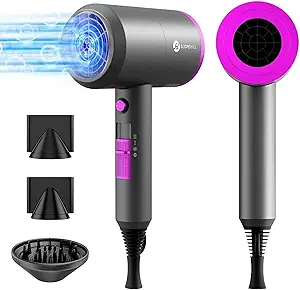
Slopehill Hair Dryer with Brushless Motor
With 3,461 ratings backing it up, this is a well-proven option. The brushless motor delivers strong, consistent airflow, and the built-in ion emission system does real work keeping hair smooth rather than just claiming to.
Pros:
- High-speed brushless motor for strong airflow
- Lightweight and easy to handle
- Built-in ion emission system for smooth, shiny hair
Cons:
- Attachments can get very hot during use, handle with care mid-session
- Higher price compared to other models
- Some users find it louder than expected
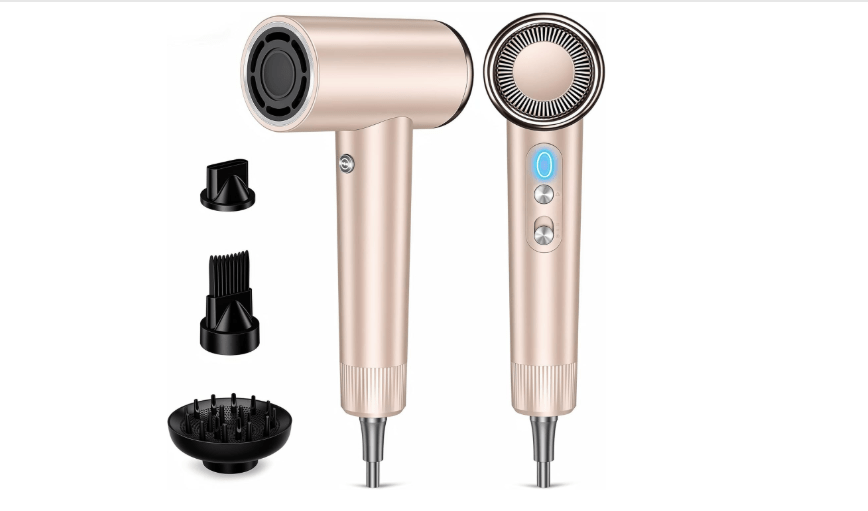
Ionic Hair Dryer, 150000 RPM, Ceramic Nozzle, 3-Speed Settings
A genuinely travel-friendly option: compact, lightweight, and quiet thanks to dedicated noise reduction technology, while still delivering fast drying from its high-RPM motor.
Pros:
- Compact and lightweight, ideal for travel
- Fast drying from a powerful motor
- Quiet operation via noise reduction technology
Cons:
- The hottest setting runs cooler than some users expect
- No diffuser attachment included despite appearing in product photos, worth double-checking the listing before buying if you specifically want one
- Some buyers received an all-white unit instead of the gold-accented version shown
High-Speed Hair Dryer with 500M Negative Ions
Built around advanced ionic technology for reducing frizz and static, with genuinely fast drying times that suit busy mornings.
Pros:
- Dries hair extremely fast, saving real time
- Reduces frizz and static via advanced ionic technology
- Lightweight and easy to handle
Cons:
- Handle may feel short for some users
- Buttons are placed close together, easy to mispress
- Priced higher than some comparable models
150000RPM Professional High-Speed Hair Dryer
The highest-rated dryer on this list at 4.9 stars. A digital display sets it apart, giving precise control over heat and speed rather than guessing between fixed settings.
Pros:
- Powerful motor for genuinely fast drying
- Digital display for precise control
- Lightweight and quiet design
Cons:
- Buttons can be pressed accidentally during use
- The high heat setting may run hotter than some users prefer
- Priced higher than several other options here
Slopehill Professional Ionic Hair Dryer
The most-reviewed dryer here by a wide margin, over 12,000 ratings, and the most affordable. It doesn’t outperform the premium options above, but it covers the fundamentals well: useful attachments, a compact travel-friendly build, and genuinely solid performance for the price.
Pros:
- Affordable price with genuinely good performance
- Useful attachments for different styling needs
- Compact and travel-friendly design
Cons:
- Heavier than some other models on this list
- The cool shot button must be held down rather than toggled
- May not be as durable long-term as higher-end models
Keeping your hair dryer performing well
A few habits genuinely extend a hair dryer’s working life and keep airflow strong:
- Clean the air intake filter regularly. Hair and dust build up on the back vent over time, and a blocked filter is one of the most common causes of a dryer that “used to be powerful” losing performance or overheating. Most filters pop off for a quick clean, check your specific model’s manual.
- Don’t wrap the cord tightly around the body for storage. This is the single most common cause of internal cord damage over time; a loose coil or a dedicated cord clip is gentler on the wiring.
- Let it cool before storing. Putting a hot dryer straight into a bag or drawer traps heat against the casing and attachments, worth a minute of patience.
- Avoid using it in the bathroom near water sources unless the model is specifically rated for it, most aren’t, and it’s a genuine safety issue, not just a durability one.
Frequently asked questions
What’s the difference between a 100,000 RPM and 150,000 RPM hair dryer?
Generally, faster drying and slightly more airflow force at the higher RPM, but the practical difference is smaller than the numbers suggest. Nozzle design, wattage, and overall build quality affect real-world performance as much as raw motor speed.
Do I actually need dual voltage?
Only if you travel internationally. A dual-voltage dryer works anywhere with just a plug adapter. A single-voltage dryer needs a full voltage converter abroad, skipping this can damage the device or pose a safety risk.
Does negative ion technology actually do anything, or is it marketing?
It’s real, though modest. Ionic dryers genuinely reduce frizz and static and can leave hair looking shinier, but don’t expect a dramatically different drying experience purely from the ionic feature.
Why does my hair dryer feel less powerful than when I bought it?
Almost always a blocked air intake filter. Clean it first before assuming the motor itself has degraded, this single step resolves most “lost power” complaints.
Is a higher price always worth it for a hair dryer?
Not necessarily. Several of the most-reviewed and highest-rated options here sit at the more affordable end. Extra spend generally buys you more attachments, digital controls, or travel-specific features like dual voltage, not dramatically better core drying performance.
How many attachments do I actually need?
Depends on your hair and routine. A diffuser matters for curly or wavy hair, a concentrator nozzle helps with precision styling, and a cool-shot function helps set a style once finished. If you’re only doing a basic daily dry, a single well-designed nozzle is often all you need.
Looking for more tested buying guides? Check out our picks for desk gadgets that actually improve your home office setup or the best running gear worth buying in 2026.