Thousands of channels have been demonetised, labelled without warning, or suspended over AI content rules they didn’t fully understand, and the frustrating part is that most of those creators weren’t doing anything obviously wrong. The confusion is understandable: platform policy in this area has moved fast, and the rules are more specific than a simple “did you use AI” checkbox. This post breaks down what actually triggers a penalty on the major platforms, what’s completely safe, and how to stay compliant without overthinking every edit you make.
It’s one part of the AI Voice Education hub, itself a section of the broader AI Voice Tools for Content Creators guide.
In this post, you’ll learn:
- The one test platforms actually use to decide if content needs an AI disclosure label
- What’s completely exempt, even though it technically involves AI
- How YouTube, TikTok, and Meta differ in their detection and enforcement
- Whether disclosing AI use actually hurts your reach or monetization
The Test That Actually Matters
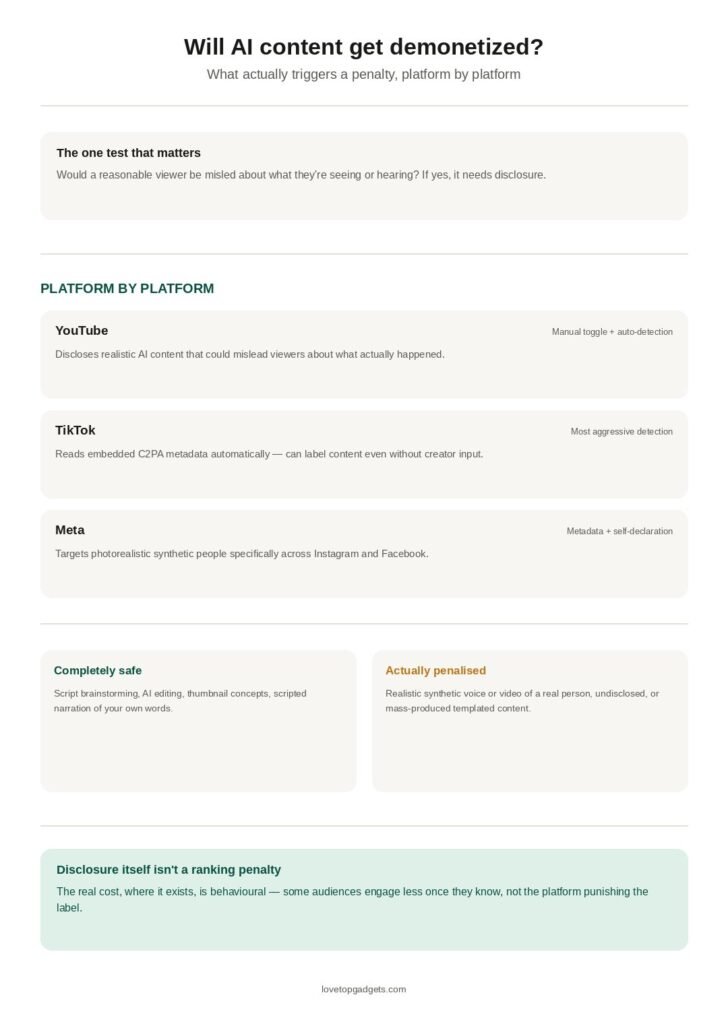
Every major platform’s policy comes down to a version of the same question: would a reasonable viewer be misled about what they’re seeing or hearing?
If AI helped generate or significantly alter content that could pass as an unaltered recording of real events, it needs disclosure. If it’s obviously stylised, clearly fictional, or just an editing aid, it generally doesn’t.
This is why so many creators over-worry or under-disclose. Using AI to write a script, generate a thumbnail concept, clean up captions, or apply a filter doesn’t trigger anything on any major platform.
Using AI to generate a photorealistic voice or face, the kind covered in how AI voice cloning works and the ethics every creator should know, that could pass as an unscripted real recording is a different situation entirely.
Platform-by-Platform Breakdown
| Platform | What triggers disclosure | Detection method |
| YouTube | Realistic AI-generated or altered content that could mislead a viewer about what actually happened | Manual toggle at upload, backed by an automated detection system that flags undisclosed synthetic content |
| TikTok | Realistic-appearing people, places, or events generated or significantly altered by AI | Creator self-labelling plus automatic detection through embedded C2PA Content Credentials metadata |
| Meta (Instagram & Facebook) | AI-generated or materially altered visual, audio, or text content, especially photorealistic synthetic people | C2PA metadata detection where available, self-declaration required otherwise |
TikTok currently runs the most aggressive enforcement of the three. Its system reads embedded content credentials automatically, meaning it can detect and label AI-generated content even if a creator never adds the label themselves, and unlabelled content the system catches can lose distribution or ad earnings, at least temporarily, even after a retroactive fix. YouTube and Meta rely more heavily on creator self-disclosure, backed by their own detection systems for content carrying recognisable AI metadata.
What’s Completely Safe, No Disclosure Needed
- Using AI to brainstorm scripts, titles, or video ideas
- AI-assisted editing, colour correction, or standard filters
- AI-generated thumbnail concepts
- Clearly fictional, animated, or stylised content that no reasonable viewer would mistake for a real recording
- AI-generated voice narration of your own scripted content, where it’s not standing in for a real, unscripted human moment
What Actually Gets Penalised
- Realistic synthetic voice or video depicting a real person saying or doing something they didn’t, without disclosure
- Mass-produced, templated, repetitive AI content with no real original input, which YouTube’s inauthentic content policy specifically targets for demonetisation regardless of disclosure
- Undisclosed AI content that a platform’s own detection system catches, since several platforms penalise the failure to disclose more heavily than the AI use itself
Does Disclosing AI Use Actually Hurt You?
By policy, no. YouTube states directly that disclosure doesn’t affect how content ranks, and properly labelled AI content earns comparable revenue to other content in the same niche. The label itself isn’t a visibility penalty on any of the major platforms.
Where there’s a real cost, it’s behavioural rather than algorithmic: some audiences engage less once they know content is AI-made. That’s a trust and content-quality question, not a platform punishment, and it connects directly to what audiences can (and can’t) actually tell when AI content is standing in for the real thing. Platforms are consistently rewarding the parts of a video only a real person could bring: perspective, judgement, a genuine point of view, and that’s unlikely to change as detection gets more sophisticated, not less.
FAQ
Will using an AI voice for narration get my channel demonetised?
Not on its own. The issue is realism combined with a lack of disclosure, specifically content that could pass as an unscripted real recording. Clearly narrated content with proper disclosure where needed is not a monetisation risk.
Do I need to disclose AI use if I only used it to write my script?
No. Every major platform exempts production-assistance uses like scriptwriting, editing, and thumbnail generation from disclosure requirements.
Which platform enforces AI disclosure most strictly?
TikTok currently has the most automated, aggressive detection of the three, since it reads embedded content credentials and can label or restrict content regardless of what the creator discloses.
Can undisclosed AI content still get caught even if I don’t label it?
Yes, on platforms with automated detection, including YouTube and TikTok. Skipping the label doesn’t mean it goes unnoticed, and the penalty for being caught without disclosure is generally worse than disclosing upfront.