A finance worker in Hong Kong was tricked into sending $25 million after a deepfake video call convinced them it was genuine. A mother in Arizona paid a ransom to scammers using a cloned version of her own daughter’s voice, built from nothing more than recordings already public online. These aren’t edge cases anymore, they’re the sharp end of a technology that’s now accessible to anyone with a laptop. If you publish your voice online regularly, whether that’s YouTube narration, podcasting, or course content, you’re a more visible target than most people realise.
This post covers practical, non-technical steps to lower your risk, plus exactly what to do if you discover your voice has already been cloned without permission, one of the questions we work through across the AI Voice Education hub, part of our AI Voice Tools for Content Creators guide.
In this post, you’ll learn:
- Simple habits that reduce your exposure to unauthorised voice cloning
- What a family or team safe word protocol is, and why it matters even if you’re not a public figure
- The tools and services built specifically to detect and track misuse of your voice
- The exact steps to take if you find a cloned version of your voice being used without consent
Reduce Your Exposure Before It Becomes a Problem
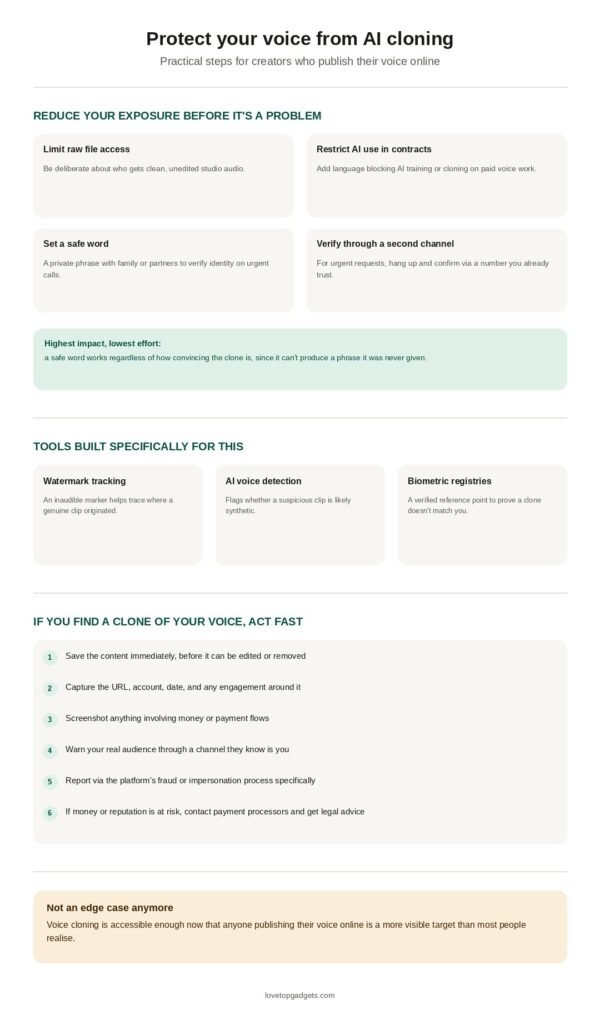
Limit access to clean, high-quality voice files
Clean, isolated audio, the kind with no background noise and clear pronunciation, is exactly what makes a high-quality clone possible, using the same techniques covered in how AI voice cloning works and the ethics every creator should know. This doesn’t mean hiding your voice; it’s already public if you publish content. But it’s worth being deliberate about who has access to raw, unedited studio files versus the final published version.
Add AI-use restrictions to contracts
If you do any paid voice work, whether that’s sponsorships, guest narration, or licensing a clip, add explicit language restricting AI training or cloning use of the material. This is increasingly standard practice, and most reputable clients won’t object to it.
Set up a safe word protocol
This is the single highest-impact, lowest-effort step available, and it takes about two minutes. Agree a private phrase with close family, friends, or business partners that would only be used to verify identity in an urgent phone call or voice message. If someone calls sounding distressed and asking for money or sensitive information, the safe word confirms whether it’s really them, no technology required on your end at all.
Verify urgent requests through a second channel
If you get an urgent voice message or call asking for money, credentials, or anything sensitive, hang up and contact the person directly through a different channel you already trust, a text to their known number, not a reply to the call itself, before acting.
Tools Built Specifically for This
- Watermark-based tracking services embed an inaudible marker into your published audio, making it possible to identify where a genuine clip originated if a clone surfaces elsewhere
- AI voice detection tools analyse suspicious audio to flag whether it’s likely synthetic, useful for checking a clip you suspect might be a clone of you or someone you know
- Vocal biometric registries let you register your voice as a verified reference point, which can strengthen your case if you ever need to prove a clone doesn’t match your authenticated voiceprint
None of these tools are perfect or foolproof, but layered together with the habits above, they meaningfully raise the effort required to misuse your voice successfully.
If You Find a Clone of Your Voice, Act Fast
- Save the content immediately: download or screen-record the audio or video before it can be edited or removed, where platform rules and local law allow
- Capture everything around it: the URL, the account name, the post date, captions, and any comments or engagement
- Take screenshots of anything involving money: payment requests, ad creative, landing pages, or checkout flows tied to the impersonation
- Warn your real audience through a channel they know is genuinely you, your official website, verified social account, or email list, so a fake version can’t get ahead of you
- Report it through the platform’s fraud, impersonation, or rights-infringement process specifically, rather than a general content report, since these get routed differently. Exactly how each platform handles it is covered in full in whether platforms actually penalise AI-assisted videos.
- If money or serious reputational harm is involved, contact the relevant payment processor or ad platform directly, and consider getting legal advice, particularly if you’re in a state or country with specific voice-likeness protections
FAQ
Can someone legally clone my voice without asking me?
Increasingly, no. A growing number of US states have extended right-of-publicity protections specifically to voice, and several countries now require disclosure when AI-generated voices are used commercially. That said, protections and enforcement still vary significantly by location.
Is a safe word really effective against a convincing AI voice clone?
Yes, because it doesn’t rely on spotting the clone technically. Even a flawless clone can’t produce a phrase it was never given, which makes this one of the few defences that works regardless of how good the underlying technology gets.
What if the cloned content is clearly parody or satire?
Parody isn’t an automatic legal shield, and how it’s treated depends heavily on jurisdiction and context. If a clone is being used to deceive or cause real harm rather than for clearly signposted commentary, it’s worth treating it seriously regardless of the parody label.
Do watermarking tools actually stop misuse?
They don’t prevent cloning outright, but they help you prove origin and track where a clone came from after the fact, which matters a great deal for takedowns and any legal action.