Three seconds of clean audio is now enough to build a recognisable voice clone. That’s not a hypothetical. It’s roughly what current voice cloning systems can manage, with quality improving the more audio you feed in.
If you’ve ever wondered how a tool takes a short recording of your voice and turns it into narration for an entire video, the mechanics are genuinely interesting, and understanding them makes it a lot easier to see where the real ethical and legal lines actually sit.
In this post, you’ll learn:
- The two-stage process behind how a voice gets cloned
- Why a few seconds of audio is enough, and why more still helps
- What’s legally required before you clone a voice that isn’t your own
- How to disclose AI voice use responsibly without overcomplicating it
The Mechanics: How a Voice Actually Gets Cloned
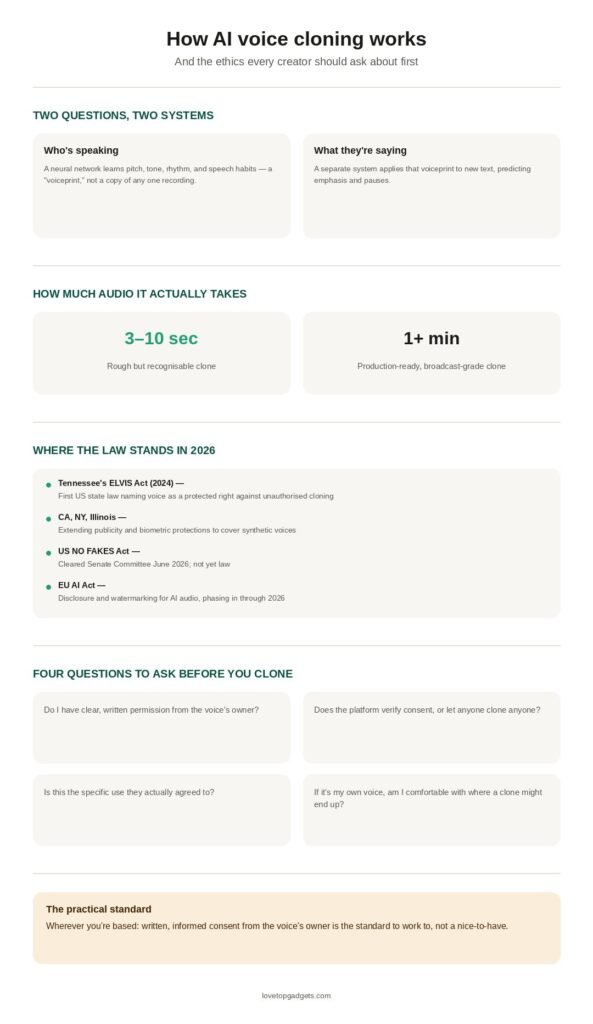
Most modern systems split the problem into two separate questions: who is speaking, and what are they saying. A neural network analyses a sample of someone’s voice and learns the characteristics that make it recognisable, things like pitch, tone, rhythm, and the small habits in how someone speaks. That learned profile is sometimes called a voiceprint, essentially a mathematical fingerprint of the voice rather than a copy of any specific recording.
A separate system then takes new text and generates speech that applies that voiceprint to words the original person never said. The better systems don’t just paste the voice onto flat, robotic speech. They predict where emphasis and pauses should fall based on the text itself, which is why a good clone can sound like it’s genuinely reading with feeling rather than reciting.
On the input side, current tools can produce a rough but recognisable clone from as little as three to ten seconds of clean audio. Quality improves noticeably with more, and professional-grade clones built for broadcast use typically train on a minute or more of high-quality recording. Background noise, a poor microphone, or flat delivery in the source audio all drag quality down, so the old advice about recording in a quiet room with a decent mic still applies here.
Why This Matters More Than the Technology Itself
None of this is illegal or unusual to build. Cloning your own voice, or a voice you have clear permission to use, is standard practice now for narration, accessibility, dubbing, and localising content into other languages. The issue is entirely about consent: cloning someone else’s voice without their permission is a different situation altogether, and the legal ground under that has shifted substantially in the last two years.
What the Law Actually Says
Tennessee’s ELVIS Act, passed in 2024, was the first US state law to explicitly name a person’s voice as a protected right against unauthorised AI cloning, and it allows claims not just against whoever made the clone but against anyone who knowingly distributed it. Several other states, including California, New York, and Illinois, have extended existing right-of-publicity or biometric protections to cover synthetic voices too, and more legislation is moving through various states as this guide is being written.
At a federal level in the US, the NO FAKES Act would create a national, licensable property right covering voice and visual likeness, with penalties for anyone who knowingly distributes an unauthorised digital replica. The 2026 version of the bill, backed by bipartisan sponsors, was reported out of Senate Committee in June 2026 and now includes a DMCA-style counter-notification process for anyone who believes their content was wrongly flagged. It still has to pass both chambers and get signed before it’s law, so treat it as a strong signal of where the rules are heading rather than a rule in force today. In the EU, the AI Act has introduced rules requiring AI-generated audio to be disclosed, with formal watermarking requirements for providers phasing in through 2026.
The practical takeaway, regardless of exactly which law applies to where you’re based or where your audience is: written, informed consent from the voice’s owner is the standard you should be working to, not a nice-to-have. Reputable AI voice platforms have started building this in directly, requiring some form of verified consent before they’ll process a clone at all, one of several questions our AI Voice Education hub works through as part of the wider AI Voice Tools for Content Creators guide.
The Consent Question Every Creator Should Ask
- Do I have clear, ideally written, permission from the person whose voice this is?
- Does the platform I’m using verify consent before creating a clone, or does it let anyone clone anyone?
- Am I using this for something the voice owner actually agreed to, not just technically allowed but the specific use they said yes to?
- If I’m cloning my own voice, am I comfortable with that synthetic version potentially being used somewhere I didn’t intend?
If you’re worried about the reverse situation, someone cloning your voice without asking, how to protect your voice and likeness from AI cloning misuse covers practical steps and what to do if it’s already happened.
Disclosure: The Part Creators Often Skip
Separate from legal consent, there’s a simpler question: does your audience know they’re hearing an AI voice? This isn’t just good ethics; it’s increasingly a platform requirement, covered in full in whether platforms actually penalise AI-assisted videos. The safest habit is a straightforward one: if a reasonable viewer might assume they’re hearing a real, unscripted human voice and they’re not, say so. A short line in the description or an on-screen label costs you nothing and heads off exactly the kind of trust problem that’s much harder to fix after the fact.
FAQ
How much audio do I actually need to clone a voice?
Some tools can produce a rough clone from three to ten seconds of clean audio. For a genuinely production-ready clone, a minute or more of high-quality recording gives noticeably better results.
Is it legal to clone my own voice?
Yes. Cloning your own voice for your own content is standard practice and not something any current law restricts.
Can I clone a celebrity’s voice for a parody or fan video?
This sits in genuinely risky territory. Right-of-publicity protections increasingly cover voice specifically, and parody is not an automatic legal shield. Written consent from the person, or their estate if they’ve passed away, is the only truly safe route.
Do I have to disclose that I used an AI voice?
Requirements vary by platform and region, but the safest approach is to disclose whenever a viewer could reasonably mistake the voice for an unscripted human one. Some regions, including the EU, are moving toward formal disclosure requirements for AI-generated audio.